Debt: The Real Culprit Behind Project Failure
What’s worse: a project failure, or the lingering questions that follow—whether the idea was truly flawed, why the project ended if it was not, and whether it is fair to judge an idea by a project’s failure or success at all?
In my latest essay, I explored the notion that optimism reflects not so much mindset as the sufficiency of one’s resources. To some extent, it explains how we decide to begin a project. Yet not every promising start leads to a successful finish. So why do resources that once seemed sufficient run out before a project is completed? Does continuing under such conditions mean going into debt? And if so, how far can that debt expand?
As a preliminary note, since I am focusing on the economy of personal projects, I do not mean time or money when I speak of resources. A person’s time can be reallocated across activities, but it cannot be borrowed. Money, by contrast, can be borrowed, yet it plays only a minor role in most personal projects before they are commercialized. For that reason, I set both aside and focus instead on energy.
Personal energy is a tricky substance: we do not have a lithium-ion battery inside us that can measure our power in milliampere-hours. A reader may argue that apps like Welltory can track a parameter called “battery”. That is true, but such measurements can differ drastically from how we actually feel. Subjective perception, therefore, is a more suitable way to assess personal energy.
To illustrate the idea, consider Emily, a project manager who took a vacation after an intense commercial project. Fortunately, the vacation was flawless and long enough for her to recover fully. The day after she returned, she was overflowing with ideas and annoying her colleagues with her proactiveness. That condition represents 100% battery. Before the vacation, by contrast, she could barely reply to her colleagues’ messages, let alone perform her tasks. That state was closer to 1%.
Because Emily’s project was commercial, it did not fail because of her condition. In a team, people rarely run out of energy all at once, so a strong group can usually compensate for one teammate’s energy bankruptcy. Had it been a personal project, however, the situation would have unfolded differently. Relying solely on her own resources, Emily would have been forced to borrow from her future self. This may work in the short term, but in the long run there will eventually be nothing left to borrow. That is bankruptcy.
However, I have said nothing about Emily’s project idea, because it hardly matters when explaining project failure. A project may lie in ruins, yet its idea can remain alive, untouched by decay. Ideas are fluid, dynamic, and flexible—even the ideas behind successful projects constantly adapt to changing circumstances. Ideas are innocent; poor resource management is the real culprit behind failure.
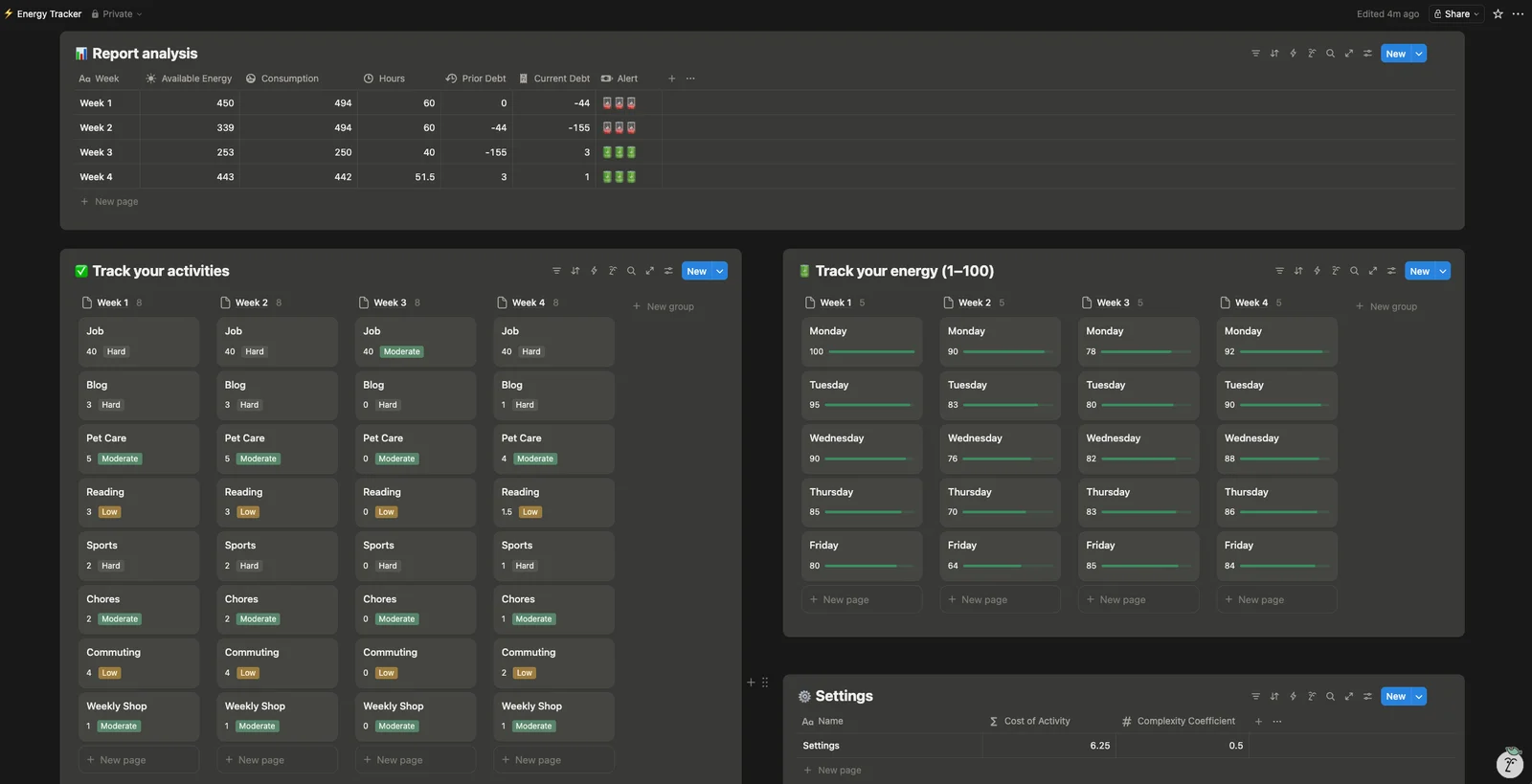
I built a Notion template to detect energy leaks and prevent debt. Its premise is simple: if we account for the energy available to us and the activities that consume it, we can understand the dynamic between the two. That dynamic shows us whether we should speed up or move more steadily. The template is prefilled with test data across a four-week period. This sample assumes that a person has a job, which consumes most of their energy, along with other ordinary activities. Among them is a blog, which serves as an example of a personal project. The tool shows that when we operate at an energy deficit, we are forced either to reduce our involvement in the project or to cut back on other areas of life. If the deficit becomes severe, all we can do is prioritize the job over the rest of our activities until our energy recovers.
My own projects have been thwarted many times by poor energy monitoring. Had I visualized it earlier, I would have found it easier to detect leaks and address them promptly. This tool illustrates the old truth: the steadier you move, the farther you go. That is what I want for my projects—to go further and further. I wish the same for yours. If you think my template might be useful, leave a comment and I will send you the link.