On creative work and social media
Today, society is often portrayed as a mass of people addicted to social media and unable to stop consuming content. That is probably an edge case. I, however, treat social media merely as a distribution channel. If I had nothing to share, you would hardly see me there.
Social media allows every creator to find an audience. That sounds great until you hit the “publish” button and see only a handful of views. Whether a post took an hour or a month to create, such an outcome leaves behind nothing but doubt. Am I so niche or is my post just garbage?
Alongside these doubts, there are contradictions. If we post art, it is likely to be shown to artists; if we post writing, it will probably be shown to writers. Yet people who love Dickens or Monet come from every imaginable background. Why should the things we create work differently? Social media platforms do not roll dice with content – they test it. The engagement of other creators, who are playing the same game, merely proves stronger, even though they are unlikely to be the true audience.
Views compound the more we post, while the lifespan of a single post is usually short. Since few of us can feed algorithms with masterpieces every day, creators resort to simpler yet digestible formats. Work-in-progress content is widely used for this purpose. But why should anyone care about the process behind something they have not even seen yet? Although I cannot explain it logically, these formats evidently work if creators have been copying them for years.
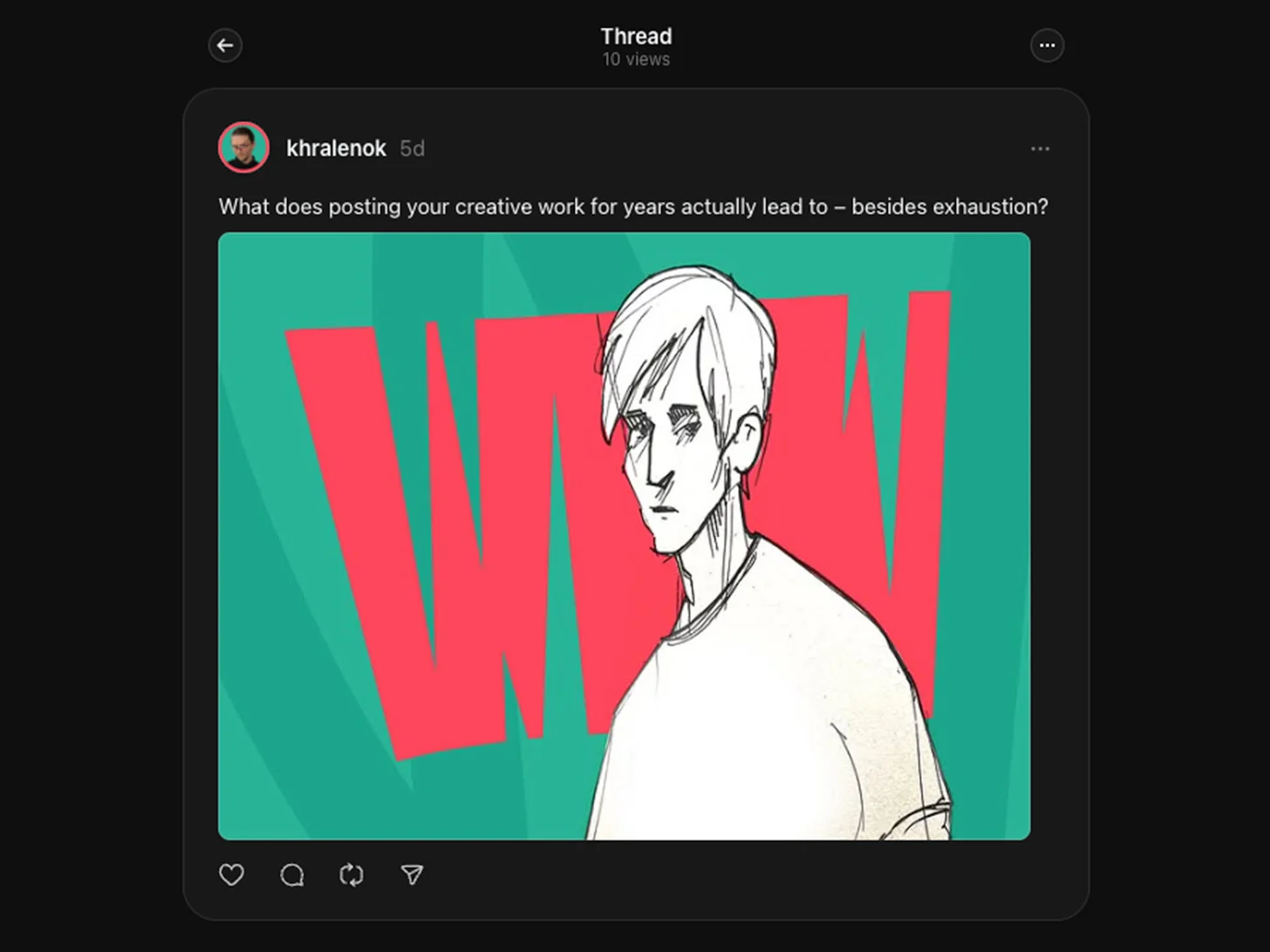
Views, however, are ambiguous signals. This week, I started posting my illustrations on Threads. The first illustration received only a few views, whereas text-only posts had previously reached hundreds. Does that mean the format itself does not work? Not necessarily. Radical changes can easily confuse algorithms, which need time to readjust. By hysterically changing formats after every drop in reach, we simply deny them that time. In the end, stubbornness pays off.
With all these complexities, it becomes easier to treat some parts of the process as chores. Commenting on other creators’ posts is one of them. Although it gives algorithms clues about where to find our audience, searching for something to comment on feels like hard labour when all you want is to create. Still, every now and then, it leads to unexpected conversations – I even wrote an essay inspired by one of them.
Social media sells shovels, yet we are the ones digging for gold. But when was it ever different? Yes, we have to engage with communities, but before the internet, creators first had to relocate to places where such communities existed and then approach people face to face. Yes, we have to adapt our creativity to certain formats, but artists of the past hardly painted aristocratic portraits out of pure inspiration. In that sense, today’s shovels are better than yesterday’s.
In the past, I searched for ways to work smart because I was afraid of working too hard. But what if things feel hard simply because they are hard? Without an audience or any clever tricks, I suspect there is nothing left to do except roll up my sleeves and keep trying.