We've Got the Power... But What For?
On AI, the collapsing cost of creation, and figuring out what comes next.
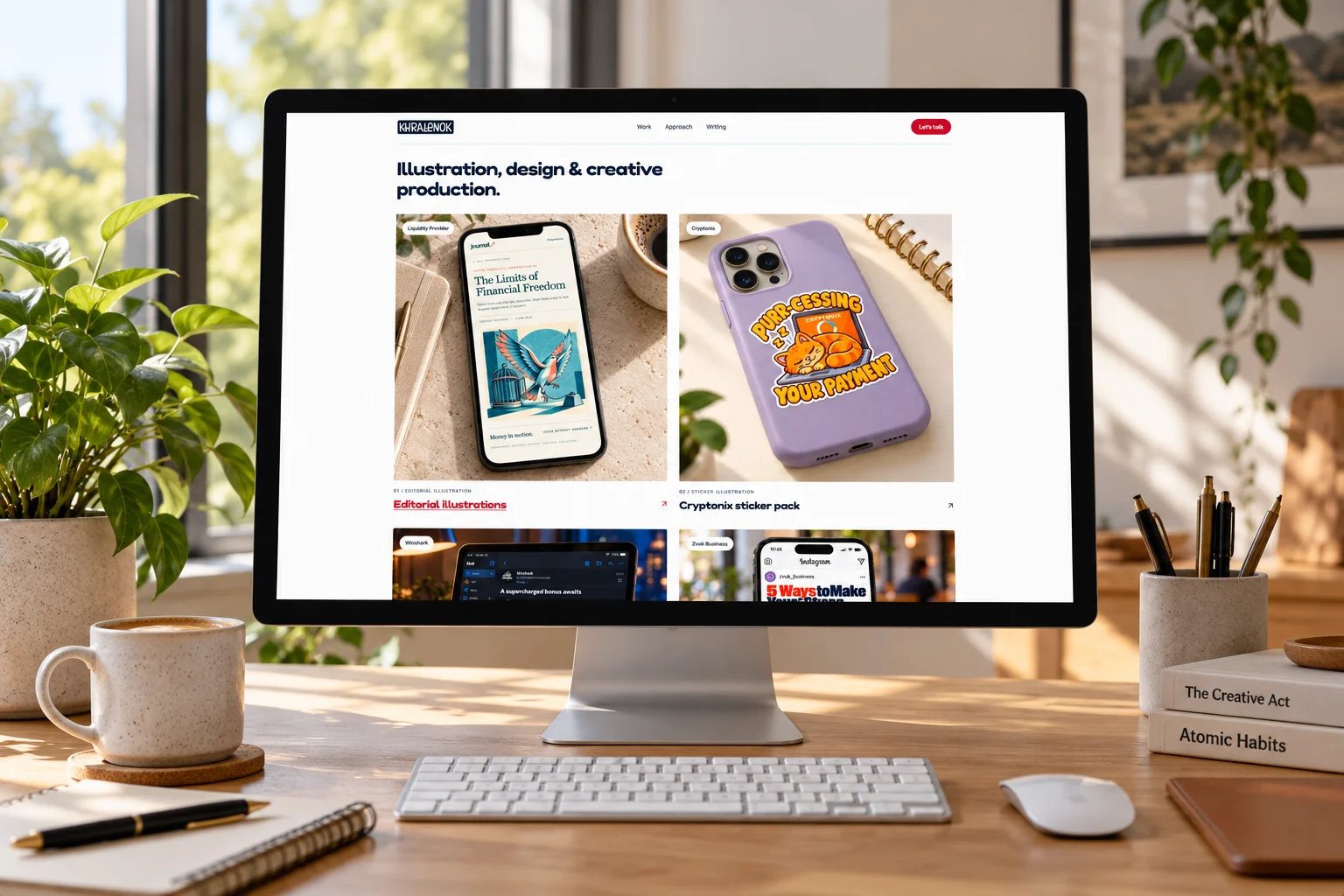
Last Friday, I spent a single day bringing four of my old illustration projects up to scratch and adding them to my portfolio. In total, I reworked 51 illustrations across four different styles, created mockups, and built custom components to showcase the projects on my website. All in one day!
Frankly, after all my previous attempts to get these projects into shape, I wouldn’t have even considered doing it without AI. These illustrations weren’t made yesterday. There are dozens of hours of work behind them. But that doesn’t change the fact that the style is inconsistent here and there, some of the geometry could be better, and as their creator, I love and hate these pieces at the same time.
A portfolio is supposed to show what I can offer a potential employer or client. Surprisingly, real projects don’t always do a great job of that. Yet reworking them manually would mean investing even more time without any clear idea of whether it would actually make a difference.
And now, something that would have taken weeks is suddenly possible in a single working day. Without even being limited to the one style you’ve spent years mastering. And if you can put together a consistent series, you can probably reproduce that kind of work at a larger scale. In a way, the result serves its purpose even better than a historically accurate case study.
And that really changes the game.
I’ve accumulated thousands of sketches, prototypes, and unfinished projects over the years. Some never reached the level I wanted because I lacked the time, budget, skills, or a good reason to invest the effort. Before AI, they had almost no chance of ever escaping the dust gathering in my archives. But today, those chances have multiplied. I already have a foundation to build on, and turning it into something substantial, even bringing it to an MVP, can now take surprisingly little time.
Which brings me to the question: what do we do with all this power?
Shouting, “Look what I can do now!” feels strange to me. Even after dozens of iterations, refinements, and corrections, the lion’s share of the actual execution belongs to the model. And a style that once took years to develop can now be copied in seconds. What remains for me, as the person operating the tools, is art direction. But art direction implies a project, something the art is actually being made for.
And, roughly speaking, I think it makes more sense now to sketch out something bigger than just another character or pose. I mean entire projects.
In the past, to pull something like that off, you’d have to organize a hackathon, get a bunch of people together, throw yourselves at an idea, and build a prototype in 24 hours. Often, only large companies had the resources to organize something like that, unless everyone was willing to volunteer their time. Today, you can do something similar at home over a weekend. And with the same amount of time and the same team, you can achieve even more. Test more hypotheses, explore the important parts in greater depth, and find something genuinely worthwhile.
And I think that’s exactly what we should be doing right now. Not because AI is cool, but because it’s hard to ignore the changes happening around us.
Like many people these days, I’m struggling to find stable, reasonably paid work. Let’s set aside the fact that AI is only one factor here. Being a Russian citizen and living in a time zone that’s far from ideal for international remote work certainly don’t help either.
But there’s a bigger problem. Research organizations are publishing reports about declining hiring, particularly in IT and related fields. Companies are reviewing their expenses, automating processes, and changing how they organize work. The value of familiar professional tasks is starting to shift.
I see it firsthand at work. Take marketing, for example.
Sure, companies keep churning out endless social media carousels, pumping out SEO articles, making ad banners, and producing mountains of corporate content. AI makes all of this cheaper, faster, and better. Most importantly, it lets us produce many times more of it. At work, I build workflows that generate hundreds of infographics in a matter of minutes.
But does that mean marketing has become proportionally more effective?
Apparently not.
At least from what I can see, marketing budgets are shifting toward influencers and independent creators who offer companies not just content, but access to an established audience and the trust they’ve built with it.
Paying someone who has already gathered a community of interested people around them is often a better deal. And even when it doesn’t work, the idea still sounds more convincing than assuming people want to read even more search-engine-optimized content or scroll through more social media carousels.
We’ve learned to produce what we used to produce much faster, but businesses don’t need more of the same. They need something different. And they don’t always know what that something is.
The only way to answer that question is through experimentation. And apparently, it’ll be up to us, the people who’ve spent years laying out designs, drawing pictures, writing copy, building landing pages, and making ads, to run those experiments.
Of course, we could reassure ourselves that AI will soon become too expensive, the bubble will burst, the hype will die down, and everything will go back to normal. But that doesn’t seem rational to me.
Every one of us has ideas, old projects, unfinished work, and experience that nobody else has. Sometimes all it takes is trying to make something that once seemed impossible or simply not worth the effort.
And yes, the results of those experiments might end up gathering dust in our archives, just like our old sketches did. So what?
You don’t need to know in advance which project will succeed. That’s the whole point of experimenting. Not every new opportunity needs to become a business plan, and you don’t have to squeeze an immediate profit out of everything you try. What matters is that you keep trying.
I don’t know what the job market will look like in five years, or how much demand there will be for my own skills. AI, for all its flaws, can already do the work I’ve been paid to do throughout my ten-year career.
I don’t see much point in worrying about preserving professional boundaries. They’ve already been breached. The line has been crossed, and all that’s left is to figure out what comes next and how to live in this new world.
I see no point in building an expert identity around a tool that’s becoming more accessible every month. So instead of saying, “Look what I can do now!” I’d rather say, “Look what we can do now!”
And if this is something we can all do, then let’s figure out what to do with it next.