
Cryptonix / Communication strategy · Sales enablement
Modular sales collateral
A newly staffed Cryptonix sales team needed materials quickly and wanted to reshape them without a designer. I built the content structure with the Sales Lead, designed the toolkit, and assembled editable templates in Google Slides.
Designer and strategist, collaborating with the Sales Lead
February 2026
- Product narrative
- Decks, one-pagers & proposals
- Editable Google Slides templates
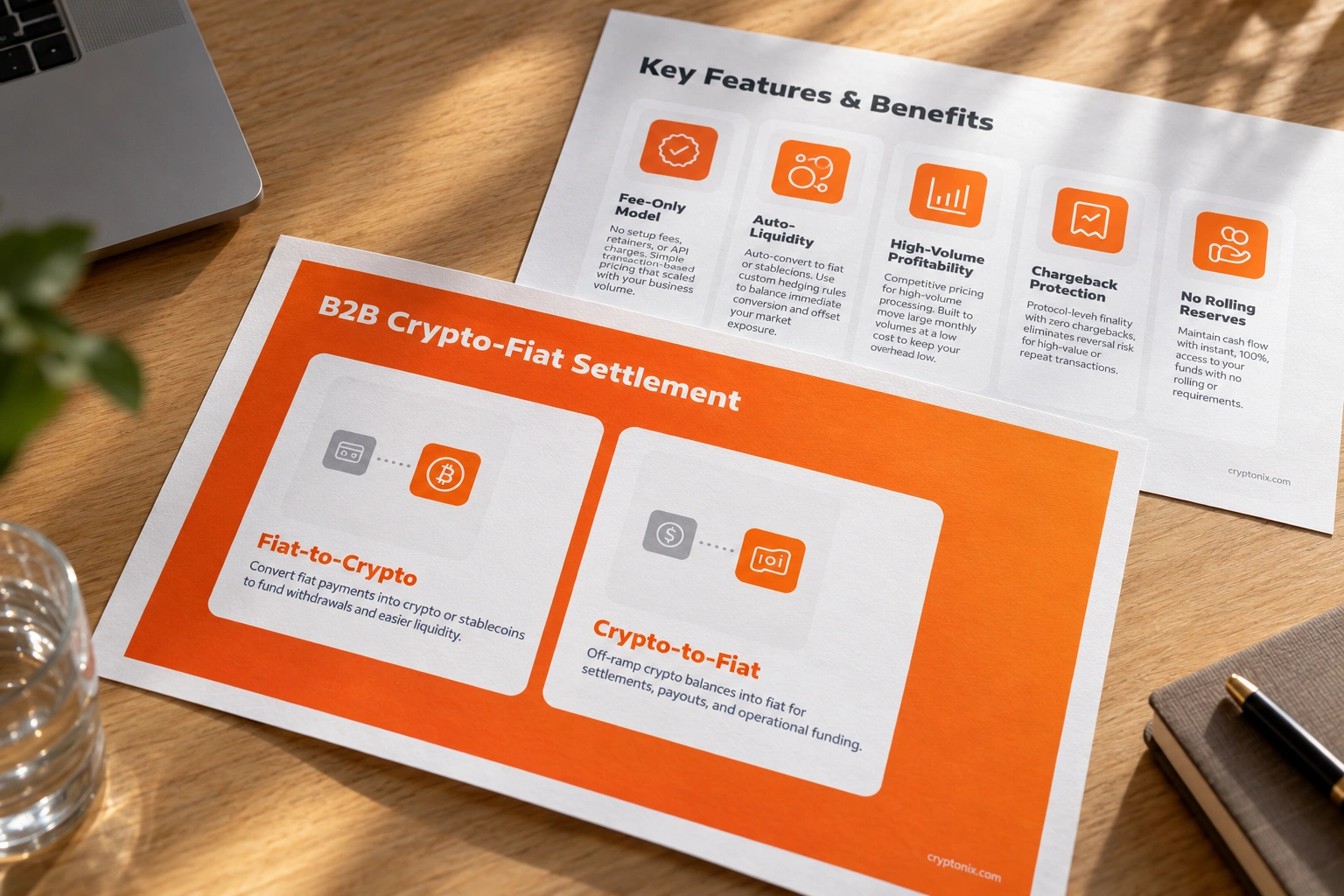
Presentation mockup based on original sales-deck artwork.
The challenge
Sales needed to start pitching with an incomplete set of materials. The product story mixed several features and integrations, making it harder to explain what a particular prospect would actually use.
My contribution
I developed the narrative skeleton, refined it with the Sales Lead, designed the visual elements, and assembled the template system for the planned industry outreach.
Start with how the product is used
Through my work with the product, I had come to see two main ways of using it: integrating through the API, or operating through the dashboard. Existing marketing descriptions focused on plugins, buttons, and checkout pages, which could obscure that simpler distinction.
I organized the material around those two paths. The Sales Lead supplied knowledge of prospects and their use cases, helping us decide which capabilities mattered in each conversation.
Build the story around the prospect
- Explain the productStart with a consistent account of what the service does.
- Choose the usage pathAPI integration or day-to-day dashboard use.
- Select relevant capabilitiesShow what matters to this prospect, such as receiving payments or making payouts.
- Complete the proposalAdapt the industry examples and commercial material.
Include the capabilities a prospect needs
A prospect needing mass payouts has a different conversation from one simply receiving payments. Some businesses need on/off-ramp capabilities; others already have payment providers and care most about fitting another service into their existing setup.
Working with sales, I adapted the content and slide variations around those needs. The toolkit covered presentations, one-pagers, and commercial proposals, with icons, cards, illustrations, and covers supporting the narrative.
Make the toolkit easy to edit
I designed at 1920 × 1080 to make transferring elements from Figma straightforward, and kept elements native to Google Slides where practical. Placeholders let the sales team replace information in familiar template layouts.
The grid supported elements spanning different widths, and the components gave editors consistent options for content. The goal was a usable working package: sales could change a pitch without rebuilding its visual structure.
Hand over work the team can use
After delivery, the team continued using the package and rarely returned for additions. That practical independence is the clearest result I observed.
I asked for feedback to guide improvements, but did not receive detailed responses. The case therefore focuses on the delivered toolkit and its continued use, without attributing sales performance to the presentation design.